Wi-Fi 7 Adoption in 2026: Why US Households Upgrade Multi-Gigabit Mesh
By 2026, a significant 43% of US households are anticipated to upgrade to Wi-Fi 7 multi-gigabit mesh routers, fueled by the increasing need for high-bandwidth applications, superior performance in dense environments, and the promise of a truly interconnected smart home experience.
The landscape of home connectivity is undergoing a profound transformation, with Wi-Fi 7 adoption poised to become a defining trend. By 2026, a substantial 43% of US households are projected to upgrade their home networks to multi-gigabit mesh routers, signaling a clear shift towards more robust and future-proof wireless technology.
The dawn of Wi-Fi 7: A new era for home networking
Wi-Fi 7, also known as 802.11be or Extremely High Throughput (EHT), represents the next major leap in wireless technology, promising speeds and efficiencies far beyond its predecessors. This upgrade isn't merely incremental; it's a foundational shift designed to meet the escalating demands of modern digital life, from ultra-high-definition streaming to immersive virtual reality and expansive smart home ecosystems.
The move to Wi-Fi 7 is driven by a confluence of factors, including the proliferation of bandwidth-hungry devices, the increasing reliance on cloud-based services, and the pursuit of a truly seamless, lag-free online experience. As households accumulate more connected gadgets, the existing Wi-Fi standards often struggle to maintain consistent performance across all devices, leading to frustration and bottlenecks. Wi-Fi 7 addresses these challenges head-on, offering a robust solution for the hyper-connected home.
Understanding the core technologies of Wi-Fi 7
At its heart, Wi-Fi 7 introduces several groundbreaking technologies that collectively contribute to its superior performance. These innovations are critical to understanding why such a significant percentage of US households are preparing for this upgrade.
- 320 MHz channels: Wi-Fi 7 doubles the channel width available in Wi-Fi 6E, allowing for significantly higher data throughput. This wider highway enables more data to travel simultaneously, drastically reducing transmission times for large files and high-bandwidth applications.
- 4096-QAM (Quadrature Amplitude Modulation): This advanced modulation scheme packs more data into each signal, effectively increasing the data rate. Imagine fitting more information into every wave that travels through your airwaves, leading to faster downloads and uploads without needing more spectrum.
- Multi-Link Operation (MLO): MLO is a game-changer, allowing devices to simultaneously send and receive data across different frequency bands (2.4 GHz, 5 GHz, and 6 GHz). This capability not only boosts speeds but also enhances reliability by providing redundant pathways and intelligent load balancing, ensuring a more stable connection even in congested environments.
- Preamble puncturing: This feature improves spectral efficiency by allowing Wi-Fi 7 devices to utilize available spectrum more effectively. If a portion of a wide channel is occupied, preamble puncturing enables the device to use the remaining clear parts of the channel, rather than waiting for the entire channel to be clear.
These technological advancements are not just theoretical; they translate directly into tangible benefits for everyday users. From reducing buffering during 8K video streams to eliminating lag in competitive online gaming, Wi-Fi 7 is engineered to deliver a superior user experience. The conclusion for this section is clear: Wi-Fi 7 is not just an evolution but a revolution in home networking, providing the necessary infrastructure for future digital demands.
The rise of multi-gigabit mesh routers: Why 43% are upgrading
The projection that 43% of US households will adopt Wi-Fi 7 multi-gigabit mesh routers by 2026 isn't a random statistic; it reflects a growing awareness among consumers about the limitations of older networking equipment and the compelling advantages of next-generation solutions. Multi-gigabit mesh systems offer a powerful combination of speed, coverage, and reliability that traditional single routers simply cannot match.

As homes become larger and more complex, and as the number of connected devices continues to climb, a single router often struggles to provide consistent, high-speed Wi-Fi throughout the entire dwelling. Dead zones, slow speeds, and dropped connections become common frustrations. Mesh systems, with their multiple nodes working together to create a unified network, eliminate these issues by blanketing the entire home with strong, reliable Wi-Fi signals.
Addressing coverage and capacity challenges
The appeal of mesh networks lies in their ability to extend Wi-Fi coverage seamlessly. Each node acts as a repeater, but with intelligent routing that ensures devices always connect to the strongest possible signal. This is particularly crucial for multi-story homes or those with architectural barriers that can impede Wi-Fi signals.
- Whole-home coverage: Mesh systems eliminate dead zones, ensuring consistent Wi-Fi in every corner of the house, from the basement to the attic.
- Scalability: Users can easily add more mesh nodes as their coverage needs expand, providing a flexible solution for growing homes.
- Intelligent routing: Devices automatically switch to the strongest mesh node without interruption, ensuring a smooth experience during movement.
When combined with Wi-Fi 7's multi-gigabit capabilities, these mesh systems transform home networking. The ability to deliver multi-gigabit speeds across a wide area means that even demanding applications, such as VR streaming or large file transfers, can operate flawlessly, regardless of where a device is located within the home. This robust infrastructure is becoming a necessity, not a luxury, for a significant portion of US households, driving the strong adoption rates predicted for 2026.
The driving forces: What's fueling Wi-Fi 7 adoption?
Several key trends and consumer demands are converging to accelerate the adoption of Wi-Fi 7 multi-gigabit mesh routers. Understanding these drivers provides insight into why such a significant investment in home networking is becoming commonplace for nearly half of US households.
One primary factor is the explosion of high-bandwidth applications. The shift towards 8K streaming, cloud gaming, and augmented/virtual reality experiences requires an unprecedented level of network performance that older Wi-Fi standards simply cannot deliver. These applications demand not only high speeds but also extremely low latency, which Wi-Fi 7 is specifically engineered to provide.
The impact of advanced applications and devices
The modern home is no longer just a place for basic internet browsing. It's a hub for entertainment, work, education, and connectivity, all relying on a robust network. The rise of sophisticated devices further emphasizes this need.
- 8K video streaming: As 8K TVs become more affordable, the demand for networks capable of streaming content without buffering increases dramatically. Wi-Fi 7's higher throughput is essential for this.
- Cloud gaming and VR/AR: These immersive experiences are highly sensitive to latency. Wi-Fi 7's low latency and high bandwidth ensure a smooth, responsive, and truly engaging experience, free from frustrating delays.
- Remote work and learning: The widespread adoption of remote work and online education has made reliable, high-speed internet a critical utility. Video conferencing, large file uploads, and collaborative tools all benefit immensely from a Wi-Fi 7 network.
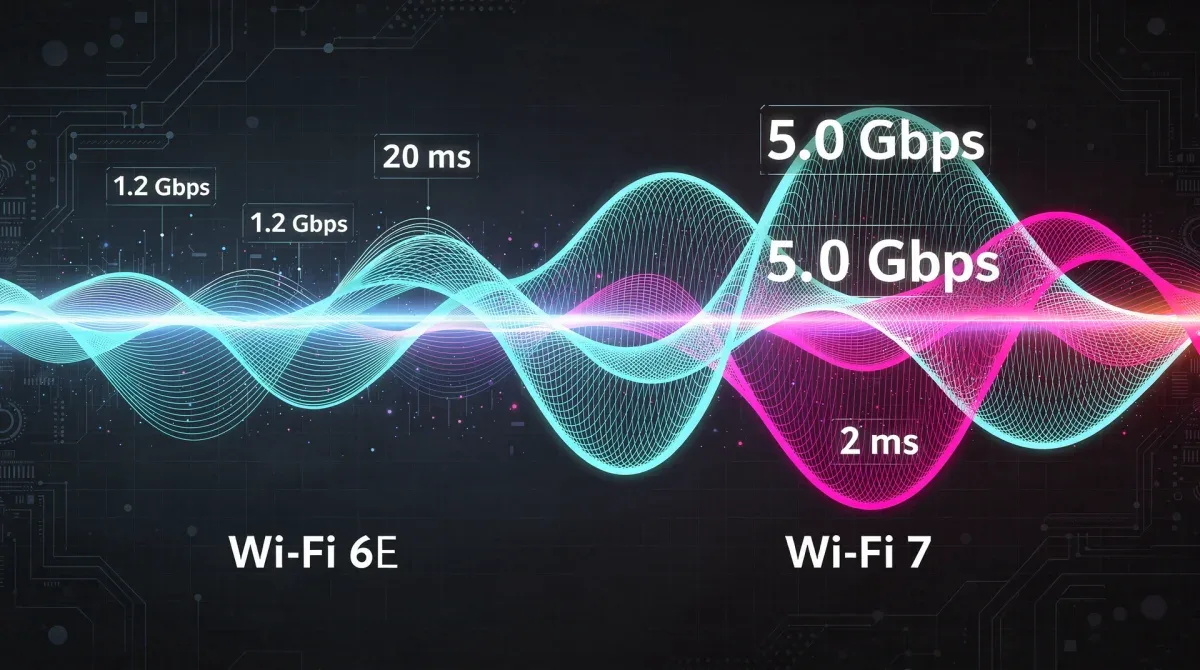
Beyond these specific applications, the sheer number of connected devices in the average US household continues to grow. Smart home devices, personal gadgets, and work-related equipment all compete for network resources. Wi-Fi 7's enhanced capacity and efficiency, particularly through features like MLO, ensure that all devices can operate optimally without degrading the performance of others. This comprehensive capability is a significant draw for consumers looking to future-proof their homes.
Overcoming the challenges of dense network environments
One of the most significant advantages of Wi-Fi 7, particularly when integrated into mesh systems, is its ability to perform exceptionally well in dense network environments. As urban areas become more populated and apartment complexes grow, the airwaves become increasingly saturated with Wi-Fi signals from neighboring networks. This interference can severely degrade performance for older Wi-Fi standards, leading to slower speeds and unreliable connections.
Wi-Fi 7 introduces several mechanisms to combat these challenges, making it an ideal solution for households in congested areas. Its advanced interference mitigation techniques and efficient spectrum utilization are key to maintaining high performance where older systems would falter. The ability to navigate these complex wireless landscapes without significant performance loss is a powerful incentive for adoption.
How Wi-Fi 7 handles interference
The innovations within Wi-Fi 7 are specifically designed to thrive in challenging environments. The technology moves beyond simply boosting speed and focuses on smarter, more resilient communication.
- Preamble puncturing: This feature allows Wi-Fi 7 access points to dynamically 'puncturing' or skip over portions of a channel that are experiencing interference. Instead of waiting for the entire channel to be clear, the network can use the clean segments, maintaining higher throughput.
- Orthogonal Frequency Division Multiple Access (OFDMA): While introduced in Wi-Fi 6, OFDMA is further optimized in Wi-Fi 7. It allows multiple users to share a channel simultaneously, dividing it into smaller sub-channels. This significantly improves efficiency and reduces latency, especially in environments with many devices.
- Multi-Link Operation (MLO) for resilience: Beyond speed, MLO also offers enhanced reliability. By simultaneously using multiple bands, if one band experiences interference, the device can seamlessly shift traffic to another, ensuring an uninterrupted connection.
These capabilities mean that even in apartment buildings where dozens of Wi-Fi networks might be operating, a Wi-Fi 7 mesh system can cut through the noise, providing a stable and fast connection. This resilience is a critical factor for the 43% of US households looking to upgrade, especially those in urban and suburban settings where network density is a growing concern. The promise of consistent performance, regardless of external interference, makes Wi-Fi 7 a compelling upgrade.
The smart home ecosystem: A catalyst for Wi-Fi 7 adoption
The proliferation of smart home devices is fundamentally reshaping how we interact with our living spaces, and it's also a significant catalyst for Wi-Fi 7 adoption. From smart thermostats and security cameras to voice assistants and automated lighting, the average US home is becoming increasingly interconnected. This intricate web of devices demands a robust and reliable network infrastructure, which Wi-Fi 7 multi-gigabit mesh routers are uniquely positioned to provide.
Older Wi-Fi standards often struggle to manage the simultaneous demands of dozens of smart devices, leading to delays, dropped connections, and a fragmented smart home experience. Wi-Fi 7's enhanced capacity, lower latency, and superior handling of multiple concurrent connections ensure that every smart device operates optimally, creating a truly seamless and responsive smart home ecosystem.
Integrating smart devices with advanced networking
The vision of a fully integrated smart home relies heavily on the underlying network. Without a powerful and efficient Wi-Fi system, the potential of these devices remains untapped. Wi-Fi 7 addresses this by providing the necessary backbone.
- Increased device capacity: Wi-Fi 7 can handle a significantly higher number of connected devices simultaneously without performance degradation, crucial for homes with numerous smart gadgets.
- Lower latency for automation: Instantaneous responses from smart devices (e.g., turning on lights, adjusting thermostats) depend on low latency. Wi-Fi 7 ensures commands are executed without noticeable delay.
- Enhanced security for IoT: While not a direct Wi-Fi 7 feature, the advanced capabilities of Wi-Fi 7 routers often come with improved security protocols and features, better protecting the growing number of IoT devices from vulnerabilities.
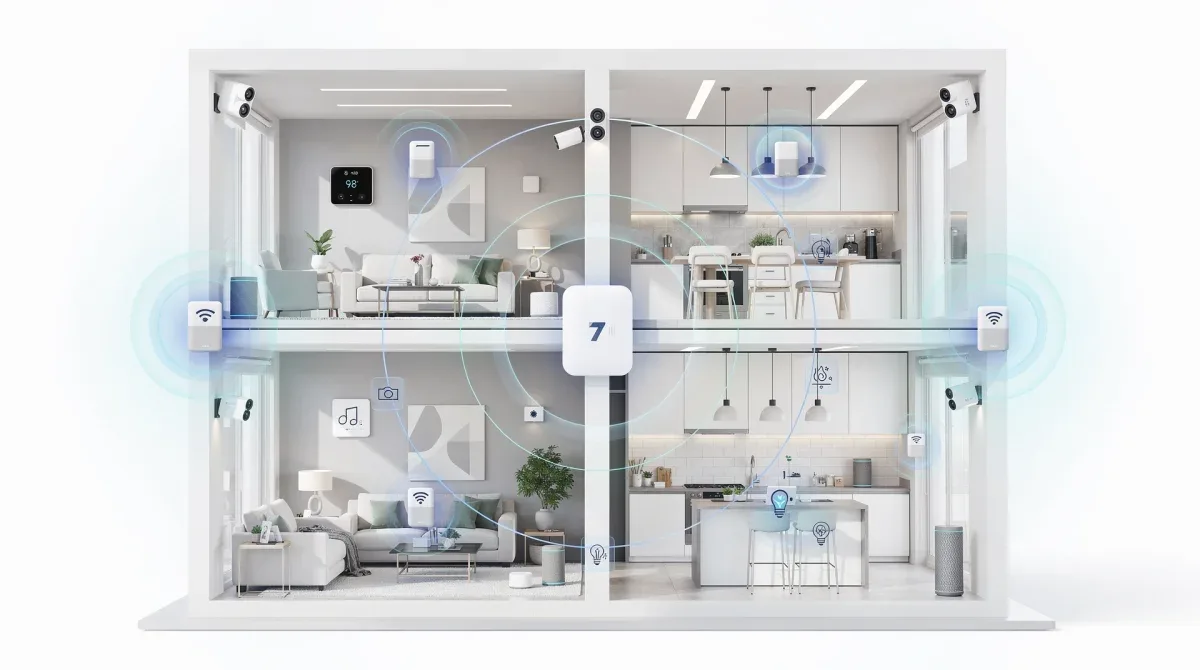
Furthermore, the multi-gigabit capabilities of Wi-Fi 7 are essential for smart home applications that involve high-bandwidth data, such as 4K/8K security camera feeds or local streaming to smart displays. A mesh system ensures that even devices located far from the main router receive a strong signal, providing reliable connectivity for outdoor cameras, smart doorbells, and other perimeter devices. This comprehensive support for the smart home is a powerful incentive for US households to upgrade their networking infrastructure.
Preparing for the future: Longevity and investment in Wi-Fi 7
For many US households, the decision to upgrade to Wi-Fi 7 multi-gigabit mesh routers by 2026 is not just about addressing current needs but also about making a strategic investment in the future. Technology evolves rapidly, and choosing a networking standard that offers significant headroom for growth is a wise decision. Wi-Fi 7 is designed to be future-proof, capable of supporting emerging technologies and applications that are still on the horizon.
The longevity of a Wi-Fi standard is a key consideration for consumers. Investing in a Wi-Fi 7 system means not having to worry about another major networking upgrade for many years, providing peace of mind and long-term value. This forward-thinking approach is a strong driver for the anticipated adoption rate.
The long-term benefits of early adoption
While the initial cost of new technology can sometimes be a barrier, the long-term benefits of Wi-Fi 7 adoption often outweigh the upfront investment. These benefits extend beyond mere speed to encompass reliability, efficiency, and adaptability.
- Future-proofing your home: Wi-Fi 7's capabilities will comfortably support advancements in VR, AR, AI-driven applications, and other future technologies, ensuring your home network remains relevant.
- Enhanced network efficiency: The advanced features of Wi-Fi 7, such as MLO and improved spectrum utilization, lead to a more efficient network that can handle more data with less energy, potentially extending the life of connected devices.
- Increased home value: A robust, modern networking infrastructure can be an attractive feature for potential homebuyers in the future, subtly increasing the appeal and value of a property.
Moreover, as more devices become Wi-Fi 7 compatible, the full potential of these networks will be realized. Early adopters will be well-positioned to take immediate advantage of these advancements as they become mainstream. The collective drive towards a more connected, high-performance future makes Wi-Fi 7 an essential upgrade, securing its place as the standard for home networking for the foreseeable future. This forward-looking perspective underpins the strong adoption forecast for 2026.
| Key Aspect | Brief Description |
|---|---|
| High Adoption Rate | 43% of US households are projected to upgrade to Wi-Fi 7 multi-gigabit mesh routers by 2026. |
| Core Technologies | Features 320 MHz channels, 4096-QAM, Multi-Link Operation (MLO), and preamble puncturing for superior performance. |
| Mesh System Advantage | Provides whole-home coverage, scalability, and intelligent routing, eliminating dead zones and ensuring consistent speeds. |
| Future-Proofing | An investment in Wi-Fi 7 ensures long-term support for emerging technologies like 8K streaming, VR/AR, and advanced smart homes. |
Frequently asked questions about Wi-Fi 7 adoption
What is driving the 43% Wi-Fi 7 adoption rate in US households by 2026?▼The adoption is primarily driven by the escalating demand for ultra-fast speeds for 8K streaming, cloud gaming, and VR/AR. Additionally, the need for seamless connectivity across numerous smart home devices and superior performance in dense network environments are key factors compelling households to upgrade.
How does Wi-Fi 7 improve upon previous Wi-Fi standards?▼Wi-Fi 7 introduces 320 MHz channels, 4096-QAM, and Multi-Link Operation (MLO). These advancements significantly boost throughput, reduce latency, and enhance network efficiency, allowing for more data to be transmitted simultaneously and improving reliability in congested areas compared to Wi-Fi 6E.
What are the benefits of using a multi-gigabit mesh router system?▼Multi-gigabit mesh systems provide whole-home Wi-Fi coverage, eliminating dead zones and ensuring consistent, high speeds across all areas. They are scalable, allowing users to add nodes as needed, and offer intelligent routing to maintain strong connections for all devices, crucial for larger homes and numerous gadgets.
Is Wi-Fi 7 considered a future-proof investment for home networking?▼Yes, Wi-Fi 7 is designed with future technologies in mind, supporting emerging applications like advanced VR, AI, and even higher resolution streaming. Its robust capabilities ensure that a Wi-Fi 7 network will remain relevant and perform optimally for many years, offering long-term value and peace of mind.
How does Wi-Fi 7 enhance the smart home experience?▼Wi-Fi 7 significantly improves the smart home experience by handling a higher density of connected devices without performance drops. Its lower latency ensures instant responses for automation, and its enhanced capacity supports bandwidth-intensive smart devices like 4K security cameras, creating a more responsive and reliable ecosystem.
Conclusion
The projected 43% adoption of Wi-Fi 7 multi-gigabit mesh routers by US households in 2026 underscores a clear and undeniable shift in consumer expectations for home networking. Driven by the relentless march of high-bandwidth applications, the expansion of smart home ecosystems, and the critical need for robust performance in dense environments, Wi-Fi 7 represents more than just an upgrade; it's an essential evolution. This next-generation standard, coupled with the expansive coverage of mesh systems, promises to deliver an unprecedented level of speed, reliability, and efficiency, effectively future-proofing homes against the ever-growing demands of our digital lives. The investment reflects a collective desire for seamless connectivity, ensuring that every device, every stream, and every interaction within the home is powered by the most advanced and capable wireless technology available.
