On-Device Voice Assistants: Sub-200ms Latency by 2026
By 2026, on-device voice assistants are poised to revolutionize smart speaker interaction, achieving sub-200 millisecond latency by eliminating cloud relays, thus delivering instant, private, and more reliable responses directly from the device.
The landscape of smart home technology is on the cusp of a significant transformation, with on-device voice assistants leading the charge. Imagine interacting with your smart speaker and receiving an answer almost instantly, without the fractional but noticeable delay caused by cloud processing. By 2026, this vision is set to become a reality, as advancements in edge computing and specialized hardware promise to cut smart speaker latency below 200 milliseconds, entirely bypassing cloud relays.
The paradigm shift to on-device processing
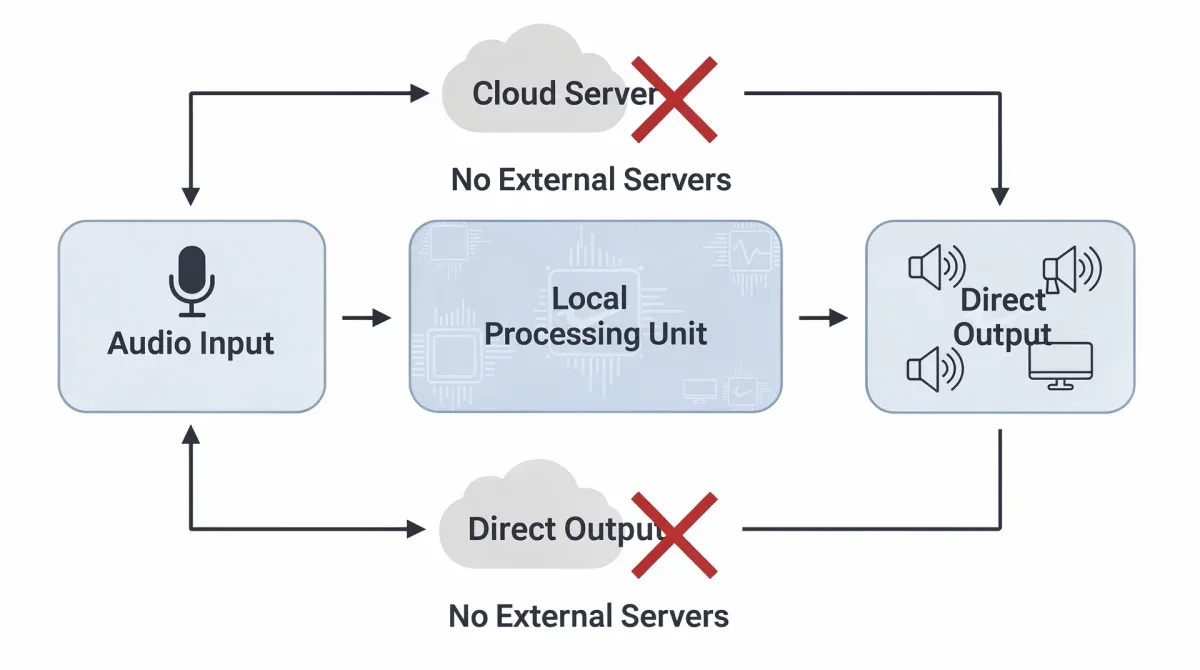
The current generation of voice assistants, while impressive, largely relies on sending audio data to distant cloud servers for processing. This round trip introduces latency, often perceived as a slight pause before a response. The move to on-device processing represents a fundamental shift, bringing computation closer to the user.
This architectural change is driven by several factors, including the increasing power efficiency of specialized AI chips and the growing demand for enhanced privacy. When data is processed locally, it never leaves your device, significantly reducing potential privacy concerns and the risk of data breaches. Furthermore, local processing ensures functionality even during internet outages, providing a more robust and reliable user experience.
Why latency matters in voice interaction
- User experience: High latency breaks the natural flow of conversation, making interactions feel clunky and less intuitive.
- Critical applications: For smart home controls or emergency services, instant responses are crucial for safety and efficiency.
- Competitive edge: Devices offering quicker responses will inherently be more appealing to consumers seeking seamless technology.

The goal of sub-200 millisecond latency is not arbitrary; it's the threshold at which human perception often ceases to notice a delay, making the interaction feel truly instantaneous. Achieving this requires a combination of highly optimized algorithms, powerful yet compact processing units, and efficient data handling directly on the device.
This shift will fundamentally change how we perceive and interact with our smart environments. No longer will we be tethered to the internet's whims for basic commands or quick inquiries. The assistant becomes a truly integral part of the device, always ready and always responsive.
Technological breakthroughs enabling low latency
Achieving ultra-low latency on-device is a complex engineering challenge, requiring innovation across multiple technological fronts. Semiconductor companies are at the forefront, developing specialized neural processing units (NPUs) and AI accelerators designed for efficient inference at the edge. These chips are optimized to perform complex machine learning tasks, such as speech recognition and natural language understanding, with minimal power consumption.
Beyond hardware, software optimizations play a crucial role. Developers are creating lightweight AI models that can run effectively on resource-constrained devices without sacrificing accuracy. Techniques like model quantization and pruning reduce the computational footprint of these models, making them suitable for on-device deployment. The synergy between advanced hardware and optimized software is paramount to reaching the sub-200ms target.
Key technological enablers
- Edge AI processors: Dedicated chips like NPUs deliver high computational power for AI tasks with low energy consumption.
- Optimized ML models: Compact and efficient models reduce processing time and memory requirements.
- Advanced signal processing: Techniques for noise reduction and voice activity detection enhance input quality, speeding up interpretation.
- Federated learning: While not purely on-device, this approach can train models more efficiently by learning from decentralized data, improving local models over time without sending raw data to the cloud.
The development of these technologies is not happening in isolation. Major tech companies are investing heavily in research and development, recognizing the strategic importance of on-device AI. This collaborative push across the industry accelerates innovation, bringing us closer to a future where voice assistants are not just smart, but also incredibly fast and reliable.
The advancements extend to the algorithms themselves, with a focus on real-time processing that can handle continuous speech without buffering. This means that as you speak, the device is already interpreting and preparing a response, minimizing any perceived delay. The integration of these components creates a robust ecosystem for truly responsive on-device intelligence.
The impact on user experience and privacy
The transition to on-device voice assistants with sub-200ms latency will profoundly enhance the user experience. Imagine asking your smart speaker for a quick fact, adjusting your thermostat, or controlling your lights, and receiving an immediate response, indistinguishable from a human conversation. This immediacy fosters a more natural and satisfying interaction, making voice assistants feel less like a tool and more like an intuitive extension of your home.
Privacy is another monumental gain. With processing happening entirely on the device, sensitive voice data never leaves your local network. This addresses a major concern for many users who are hesitant about their conversations being uploaded to cloud servers. The assurance of local processing builds trust and encourages broader adoption of voice assistant technology, particularly in environments where privacy is paramount.
Enhanced privacy benefits
- Data residency: Your voice data stays on your device, under your control.
- Reduced surveillance risk: Eliminates the possibility of third-party access to your voice recordings from cloud storage.
- Increased trust: Users are more likely to adopt technology they feel secure using, especially in their personal spaces.
- Compliance with regulations: Facilitates adherence to data protection laws like GDPR and CCPA by minimizing data transmission.
Beyond privacy, the reliability of on-device processing is a significant advantage. Internet outages or slow connections will no longer cripple your smart speaker's basic functionalities. Commands for playing music, setting timers, or controlling smart home devices will continue to work seamlessly, ensuring a consistent and dependable experience regardless of external network conditions.
This level of responsiveness and privacy will make voice assistants an even more indispensable part of daily life. The friction points that currently exist, however subtle, will largely disappear, paving the way for a truly integrated and intuitive smart home ecosystem where technology serves us without compromise.
Challenges and solutions in implementation
While the benefits of on-device voice assistants are clear, implementing them at scale presents several formidable challenges. One primary hurdle is the balance between computational power, energy efficiency, and cost. High-performance AI chips can be expensive and consume significant power, which is a concern for battery-powered devices or those designed for always-on operation.
Another challenge lies in the complexity of natural language processing (NLP). Training robust NLP models that perform accurately on limited device resources, while also being adaptable to various accents and speech patterns, requires sophisticated engineering. Furthermore, updating these models on-device without requiring large downloads or disrupting user experience is a continuous development area.
Overcoming implementation hurdles
- Hardware optimization: Designing purpose-built NPUs that deliver high AI inference per watt, making them suitable for edge devices.
- Model compression: Employing techniques like quantization and pruning to reduce model size without significant accuracy loss.
- Hybrid approaches: Utilizing on-device processing for common commands and cloud for complex queries, balancing performance and resource use.
- Efficient update mechanisms: Developing differential update systems that only download necessary changes, minimizing bandwidth and storage.
The industry is actively addressing these challenges through innovative solutions. For instance, many companies are exploring hybrid models where basic, frequently used commands are processed on-device, while more complex or less common requests are still routed to the cloud. This approach leverages the best of both worlds, ensuring responsiveness for common tasks while retaining the vast knowledge base of cloud AI.
Furthermore, advancements in manufacturing processes are making powerful edge AI chips more affordable and energy-efficient. This democratizes access to advanced on-device processing, allowing a wider range of smart devices to incorporate these capabilities. The continuous evolution of both hardware and software solutions is key to overcoming these implementation barriers and bringing low-latency on-device voice assistants to the mainstream.
The future landscape of smart speakers and beyond
By 2026, the proliferation of sub-200ms on-device voice assistants will fundamentally reshape the smart speaker market and extend its influence into various other connected devices. Smart speakers will evolve from mere internet-connected portals to truly intelligent, autonomous entities within our homes. This will pave the way for more complex and reliable local automation scenarios, where device interactions are not dependent on external servers.
Beyond smart speakers, the principles of on-device AI and low latency will permeate other consumer electronics. Imagine smart appliances, wearables, and even vehicles equipped with voice interfaces that respond with unprecedented speed and privacy. This decentralization of AI processing signifies a broader trend towards edge computing, where intelligence is distributed throughout our environment rather than centralized in distant data centers.
Future applications of on-device AI
- Smart home automation: More reliable and instant control of lights, thermostats, and security systems.
- Wearable technology: Faster voice commands for fitness trackers and smartwatches, improving user interaction.
- Automotive industry: Enhanced in-car voice assistants for navigation, entertainment, and vehicle controls, critical for safety.
- Industrial IoT: Real-time voice interaction with machinery and systems, boosting operational efficiency and safety in industrial settings.
This future vision also includes a more personalized and adaptive AI experience. On-device models can learn individual user preferences and habits over time, tailoring responses and actions without sending personal data to the cloud. This creates a deeply customized interaction that feels uniquely yours, enhancing convenience and utility.
The shift represents not just a technological upgrade but a philosophical one, moving towards a more private, reliable, and user-centric approach to artificial intelligence. The smart environments of tomorrow will be characterized by their seamless responsiveness and their ability to operate intelligently, even when disconnected from the global network, truly integrating technology into the fabric of our daily lives.

Preparing for the on-device AI revolution
As the smart home landscape rapidly evolves towards on-device voice assistants with sub-200ms latency, both consumers and developers need to prepare for this revolution. For consumers, understanding the benefits of privacy, speed, and reliability will be key to making informed purchasing decisions. Devices that clearly advertise their on-device processing capabilities and privacy features will likely gain a significant market advantage.
For developers and manufacturers, the focus shifts to designing hardware and software that can efficiently handle complex AI tasks locally. This includes investing in specialized silicon, optimizing machine learning models for edge deployment, and ensuring robust security protocols are embedded from the ground up. The ecosystem will require new tools and frameworks tailored for on-device AI development, fostering innovation in this rapidly expanding field.
Steps for embracing on-device AI
- Educate yourself: Understand the technical specifications and privacy implications of on-device versus cloud-based AI.
- Prioritize privacy: Look for devices that explicitly state local processing and strong data protection.
- Support innovation: Encourage manufacturers to invest in edge AI and low-latency solutions.
- Develop for the edge: Engineers should focus on optimizing AI models and applications for resource-constrained environments.
The transition will also necessitate new standards for interoperability and security. As more devices gain on-device intelligence, ensuring they can communicate and cooperate effectively within a smart home ecosystem becomes crucial. This collaborative effort across the industry will be vital in realizing the full potential of this technological shift.
Ultimately, the move towards on-device voice assistants is about empowering users with more control over their data and providing a superior, more reliable experience. By anticipating and adapting to these changes, we can collectively shape a future where technology is not only smart but also truly serves our needs with unparalleled speed and discretion.
The journey to seamless smart interaction
The pursuit of sub-200ms latency in on-device voice assistants is more than just a technical benchmark; it's a quest for seamless, natural human-computer interaction. The current reliance on cloud relays, while enabling powerful AI, introduces a subtle but perceptible barrier to true conversational flow. By bringing intelligence directly to the device, we are effectively removing this barrier, creating an experience that feels less like issuing commands to a machine and more like speaking to an attentive, ever-present assistant.
This journey involves a multifaceted approach, combining breakthroughs in semiconductor design, advanced machine learning algorithms, and a renewed focus on user privacy. The integration of neural processing units (NPUs) directly into smart speakers allows for the real-time execution of complex AI models, such as automatic speech recognition (ASR) and natural language understanding (NLU), without the need to send data off-device. This local processing dramatically cuts down the time from utterance to response, pushing interactions into the realm of the instantaneous.
Key elements of the journey
- Hardware acceleration: Custom silicon designed for AI inference at the edge.
- Efficient algorithms: Machine learning models optimized for speed and minimal resource consumption.
- Robust security: Ensuring data processed locally remains secure and private.
- User-centric design: Focusing on intuitive and natural interaction flows.
The implications extend beyond mere speed. Enhanced privacy, robust offline functionality, and reduced reliance on internet connectivity contribute to a more resilient and trustworthy smart home ecosystem. Users will gain greater peace of mind knowing their private conversations are processed locally, fostering deeper trust in their smart devices.
As we move towards 2026, the technology is maturing rapidly, driven by intense competition and a clear vision for the future of ambient computing. The collective effort of researchers, engineers, and product designers is converging to deliver a new generation of voice assistants that are not only intelligent but also truly integrated into the fabric of our daily lives, making every interaction effortless and immediate.
| Key Aspect | Brief Description |
|---|---|
| On-Device Processing | AI computations occur directly on the smart speaker, bypassing cloud servers. |
| Sub-200ms Latency | Response times below the human perception threshold for delay, making interactions feel instant. |
| Enhanced Privacy | Voice data remains on the device, significantly reducing privacy concerns. |
| Reliability & Autonomy | Devices function consistently even without internet access, offering greater independence. |
Frequently asked questions about on-device voice assistants
What does 'on-device' voice assistant mean?▼An on-device voice assistant processes user commands and queries directly on the smart speaker or device itself, rather than sending audio data to remote cloud servers for interpretation. This local processing significantly reduces response times and enhances user privacy by keeping sensitive data contained.
Why is sub-200ms latency important?▼Sub-200ms latency is crucial because it's generally the threshold at which human perception no longer registers a delay. Achieving this speed makes interactions with voice assistants feel instantaneous and natural, akin to human conversation, greatly improving the overall user experience and making the technology more intuitive.
How does on-device processing improve privacy?▼On-device processing enhances privacy by ensuring that your voice commands and personal data never leave your local device. This eliminates the need to transmit sensitive audio recordings to external cloud servers, reducing the risk of data breaches, unauthorized access, and concerns about how personal information is stored or used by third parties.
Will on-device assistants work without an internet connection?▼Yes, a significant advantage of on-device voice assistants is their ability to perform basic functions and common commands even without an active internet connection. Since processing occurs locally, tasks like setting timers, playing local media, or controlling smart home devices within the local network can continue to operate seamlessly, enhancing reliability.
What technologies enable this low-latency on-device processing?▼Achieving low-latency on-device processing relies on several key technologies. These include specialized neural processing units (NPUs) or AI accelerators within the device, highly optimized and compact machine learning models, and advanced signal processing techniques for efficient audio input. These components work together to perform complex AI tasks quickly and efficiently locally.
Conclusion
The advent of on-device voice assistants capable of sub-200 millisecond latency by 2026 marks a pivotal moment for smart speaker technology and the broader landscape of consumer electronics. This shift away from cloud reliance promises not only significantly faster, more natural interactions but also a substantial leap forward in user privacy and device reliability. By processing data locally, these next-generation assistants will offer an unparalleled user experience, fostering greater trust and integration into our daily lives. The future of smart interaction is immediate, personal, and profoundly on-device.
